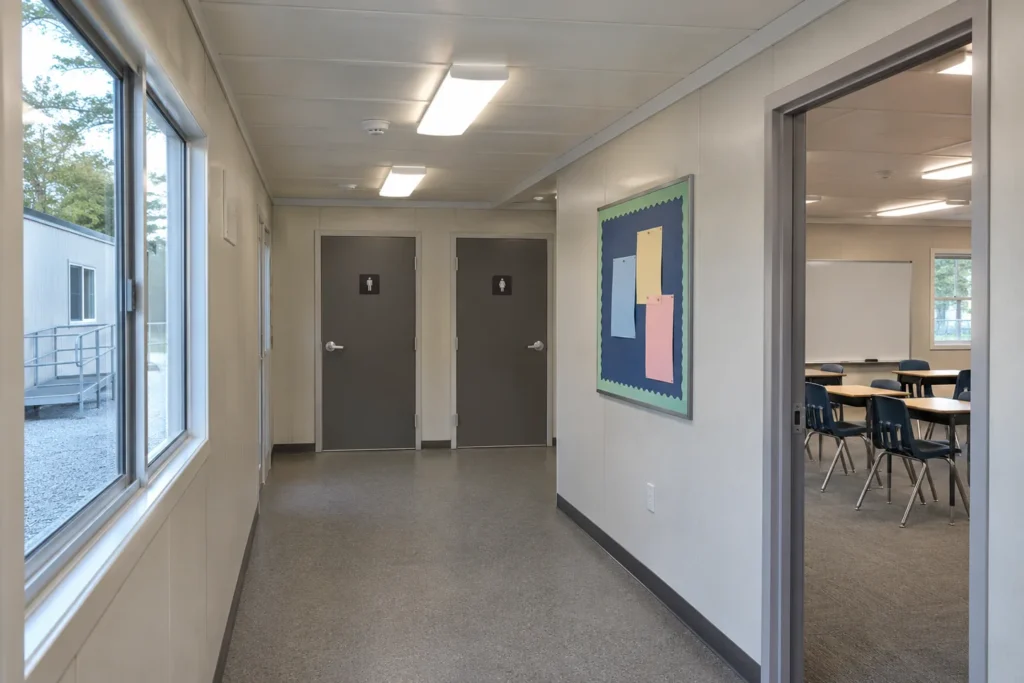
Restrooms can change how a modular classroom works as much as the teaching room itself. A separate classroom may use facilities in another campus building, while a larger classroom block may need restrooms inside. Compare modular classroom prices with that decision made clear from the beginning.
For modular classrooms, the right arrangement depends on who uses the space, how the school supervises movement and what existing facilities can realistically serve it. An apparently convenient nearby restroom may require crossing a busy service route or passing through a locked building during after-school activities.
Discuss modular classroom restrooms as part of the complete school building, including access to facilities elsewhere on campus.
Follow the student’s route
Map the actual walk from the classroom to the proposed facilities. Consider weather exposure, changes in level, arrival procedures and the school’s supervision arrangements. Review how younger students, visitors and people with mobility needs will use that route. Do not assume a location is suitable because it looks close on an aerial photograph.
Ask the school’s qualified design team to determine the required facilities and accessibility provisions. The classroom buyer’s guide provides a useful starting framework, but the specific school, occupancy and jurisdiction determine what the project must include.
Consider when the facilities will be available. A nearby campus building may close before an evening program finishes or remain locked during holiday activities. Record those operating hours alongside the physical route, because convenient access on a normal school morning does not establish that the arrangement works for every planned use.
Compare internal facilities against campus connections
Internal restrooms use part of the building footprint and add fixtures, partitions, ventilation and utility needs. External campus facilities may preserve teaching space, but they can add operational complications. Compare complete arrangements rather than treating restrooms as a small optional accessory.
Confirm the available water and wastewater connections, their locations and who will make them. Review modular building utilities with the project team. A price that covers the restroom inside the building may not cover every connection outside it. Ask for those boundaries in writing so there is no ambiguity between building and site work.
Keep cleaning and future use in the decision
Facilities staff should review cleaning access, fixture choices, storage for supplies and maintenance responsibilities. If several rooms share facilities, discuss how the arrangement works during breaks rather than only during lessons. A sensible design should support the daily cleaning routine without creating unnecessary disruption.
Before requesting final classroom building prices, identify the restroom arrangement on the same plan as the teaching rooms. Include any intended future change in use, such as a different age group or extended operating hours. That does not guarantee the building will suit every future use, but it gives the design team a chance to identify limitations early. The better comparison is the complete facility your school can use, not simply the cheapest classroom shell.