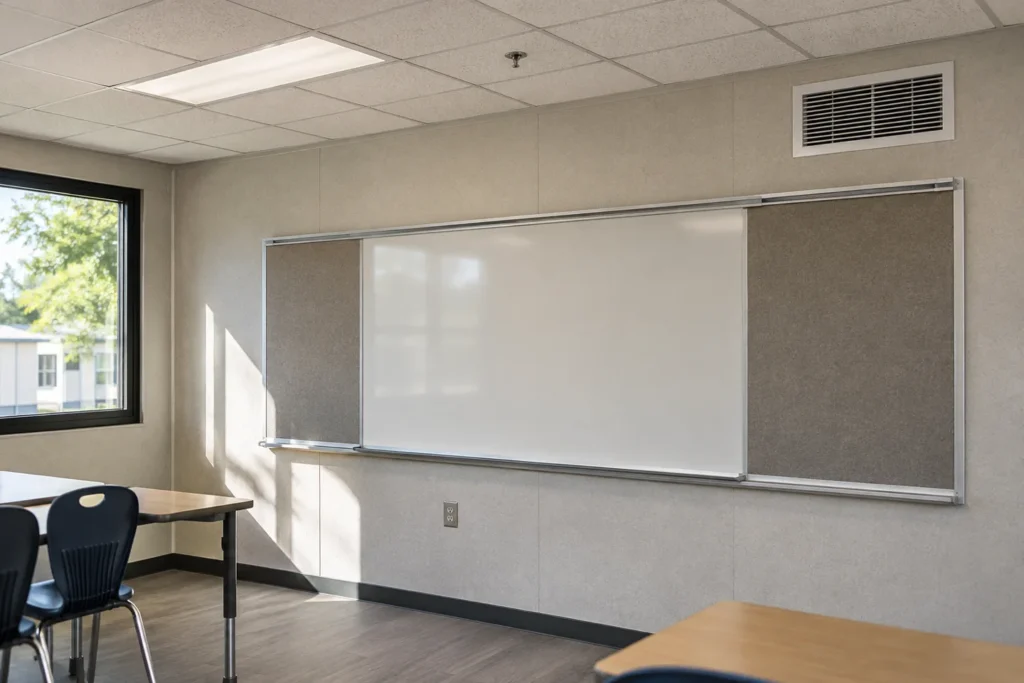
A classroom should support clear conversation, not make teachers compete with the room. When comparing modular classrooms, ask about noise inside the room, sound passing between rooms and noise from outside. These are different issues and should not be reduced to a single promise that a building is quiet.
Request modular classroom prices with your acoustic expectations included. The layout and specification for modular classrooms should reflect the teaching activities, nearby campus uses and mechanical equipment that will operate during lessons.
Review modular classroom acoustics alongside the room layout and intended teaching activities.
Identify the noise sources before choosing finishes
Explain whether the classroom will be beside a roadway, playground, sports area or mechanical plant. Inside the building, consider group activities, furniture movement and adjacent rooms. A room used for quiet individual work presents a different challenge from one used for music or active group lessons.
Ask how the proposed wall, floor, ceiling and door assemblies address those conditions. Decorative wall panels are not a substitute for an appropriate acoustic specification. Request supporting product information and have the project’s qualified designer review it against the school’s requirements.
Bring a short list of activities to the design review: ordinary speech, group discussion, recorded lessons and any amplified sound. That gives the team something concrete to assess. If a room must serve several different activities, explain which one is most important instead of expecting one generic finish package to perform equally well for everything.
Include heating and cooling in the conversation
Mechanical systems are part of the listening environment. Ask where equipment sits, how air moves and what noise information is available for the proposed installation. A general equipment brochure may not describe what people will hear in the finished room.
The classroom buyer’s guide can help connect those questions to the overall building selection. Also review the relevant utility requirements, because equipment location and service arrangements can affect both design and installation. Keep the discussion specific to the supplied system rather than assuming every modular classroom has the same acoustic behavior.
Compare documented specifications and the finished result
List the acoustic provisions included in each proposal. Identify whether particular ceiling materials, doors, seals or partition details are standard or optional. Ask who is responsible for checking the completed work and what evidence will be available at handover. Where formal acoustic testing is needed, agree on its scope before purchase.
You can then compare classroom building prices without rewarding a proposal that quietly omits important features. Keep furniture and future room use in mind as well: replacing soft finishes with harder surfaces or changing how a room is used can alter the listening environment. The goal is a practical teaching space supported by an appropriate design, not an unsupported claim that one material or construction method guarantees a silent classroom.